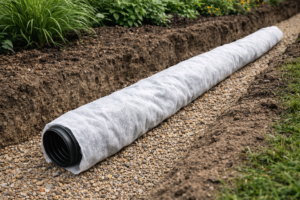
So, you’re planning a soakaway system for your garden or driveway? Great idea! A soakaway is a simple, eco-friendly way to deal with excess rainwater—helping to prevent puddles, flooding, and waterlogging around your property.
But before you start digging a big hole and throwing in loads of rubble (the old-school method), let’s talk about a smarter, more modern solution: plastic soakaway crates.

Rubble vs. Plastic Soakaway Crates
Traditionally, people built soakaways by filling a pit with rubble, broken bricks, or hardcore. While this does create some storage space for rainwater, it’s… well, not very efficient.
Here’s why:
- Limited storage space – Rubble takes up loads of room, leaving less actual void space for water.
- Harder to install – It’s heavy, messy, and time-consuming to shift tonnes of rubble around.
- Clogs over time – Soil and silt can easily build up between the rubble, reducing effectiveness.
Now compare that to modern plastic soakaway crates:
- Lightweight and easy to install – One person can lift and position them, no digger required.
- Huge water capacity – Crates are designed with up to 95% void space for water storage.
- Modular design – You can build your soakaway to the size you need, stacking or connecting crates together.
- Long-term reliability – Purpose-built with strong walls to withstand soil pressure, they keep their shape and efficiency for years.
It’s a bit like comparing a sponge (rubble) to a water tank (crates)—one is hit and miss, the other is designed to do the job properly.
Don’t Forget the Non-Woven Geotextile
Whether you go for crates or (hopefully not!) rubble, you’ll need to wrap your soakaway in a non-woven geotextile membrane.
Why? Because it’s your system’s first line of defence:
- Keeps soil out – Stops fine particles from clogging up the void space.
- Allows water in – The fabric is permeable, so rainwater flows through with ease.
- Extends soakaway life – Protects your investment so the system works effectively for many years.
At Spudulica.co.uk, you can buy geotextile cut to the size you need, perfect for wrapping around crates with minimal waste.

A Quick How-To for Your Project
- Dig your soakaway pit – Size depends on how much surface water you’re managing.
- Line the hole with non-woven geotextile – Overlap edges and leave enough fabric to wrap over the top later.
- Install the crates – Slot them together in the base of the hole.
- Wrap the crates fully – Fold the geotextile over like wrapping a present, securing with tape if needed.
- Backfill with gravel & soil – Cover over and you’re done—ready to manage rain the smart way.
Using rubble might be “free” if you’ve got some lying around, but in the long run, plastic soakaway crates + a non-woven geotextile = less hassle, better performance, and a future-proof drainage solution.
They’re lighter, cleaner, and designed to work efficiently for decades. So if you want a soakaway that really works, do it once and do it right.
Check out soakaway crate kits at Spudulica.co.uk,