So, you’ve decided a soakaway might be the answer to your rainwater problem. Great! Then comes the question almost everyone asks:
What size soakaway do I actually need?
If this is your first soakaway project, don’t be put off by talk of litres, cubic metres, roof areas and calculations. For a typical home and garden project, understanding the basics is much easier than it first sounds.
Here’s a simple place to start.
Why Does Soakaway Size Matter?
A soakaway collects rainwater and gives it somewhere to temporarily sit underground before gradually dispersing into the surrounding ground.
The amount of water your soakaway needs to deal with will depend on the area collecting that rainwater. For many homeowners, that will be a house roof, garage, extension or garden building.
A small shed roof obviously won’t collect the same amount of rainwater as a large house roof, so there isn’t one standard soakaway size that works for every project.

Start With Your Roof
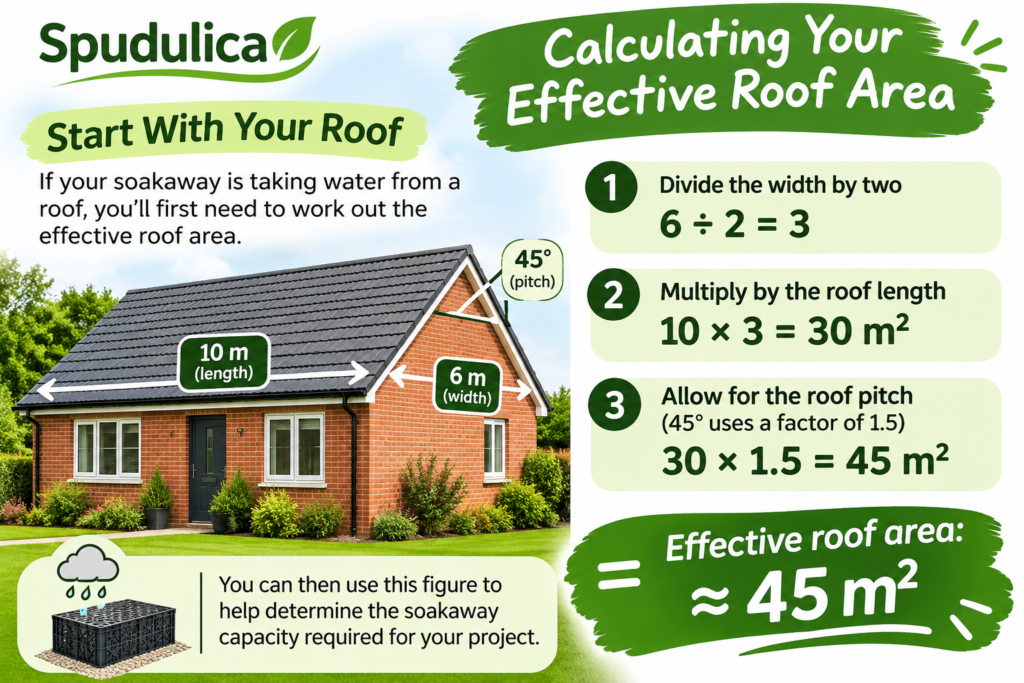
If your soakaway is taking water from a roof, you’ll first need to work out the effective roof area.
For a pitched roof, measure the length along the eaves. Then measure the width of the gable end & divide this measurement by two. Multiply those two figures together before allowing for the pitch of the roof.
The steeper the roof, the greater the effective roof area used in the calculation.
Sounds complicated? Here’s one example.
Imagine your roof is 10 metres long and 6 metres wide.
First, divide the width by two:
6 ÷ 2 = 3
Then multiply this by the roof length:
10 × 3 = 30m²
If the roof has a 45-degree pitch, the calculation method uses a factor of 1.5:
30 × 1.5 = 45m²
Your effective roof area would therefore be approximately 45m².
You can then use this figure to help determine the soakaway capacity required.
How Much Soakaway Capacity Do I Need?
As a general guide using this sizing method, every 1m² of effective roof area requires approximately 20 litres of soakaway capacity.
So an effective roof area of around 50m² would require approximately 1,000 litres, while a smaller 25m² area would require around 500 litres.
This gives you a useful starting point when looking at soakaway crates and kits.
Remember, soakaway crates come in different capacities. Once you know approximately how much overall capacity you need, you can work out how many of your chosen crates will be required to create the system.
Don’t Forget What’s Under Your Feet
Before ordering your soakaway and heading into the garden with a spade, there’s another important consideration: the ground itself.
A soakaway only works properly if the surrounding ground can absorb the water.
Soil conditions can vary enormously from one garden to another. A percolation test can help you understand how quickly water drains through your soil and whether a soakaway is suitable for your proposed location.
This is particularly important if your garden is already prone to standing water or has heavy, slow-draining soil.
It’s Not Just About the Crates
Once you’ve worked out your soakaway size, remember that the crates are only one part of the project.
A typical infiltration soakaway will also require a suitable non-woven geotextile membrane around the crates. This allows water to pass through while helping prevent surrounding soil and sediment from entering the system.
You may also need drainage pipework and, depending on where the rainwater is coming from, a suitable silt trap to help keep unwanted debris out of your soakaway.
Getting everything together before you start is much easier than discovering halfway through the job that you’re missing an important part!

Measure First, Dig Second
If you’re wondering what size soakaway you need, start with the area that’s collecting the rainwater rather than guessing how many crates to buy.
Work out your effective roof area, estimate the storage capacity required and then look at the capacity of the individual soakaway crates you’re considering.
Your ground conditions, available space and the requirements of your particular installation also need to be considered, so treat simple sizing calculations as a useful starting point rather than a substitute for checking your individual site.
Spudulica offers soakaway crates, soakaway kits, geotextile membranes and drainage accessories for home and garden projects, including options for those trickier spaces where a shallower soakaway may be required.
A tape measure, a little planning and the right kit can make tackling your first soakaway project a whole lot less daunting.