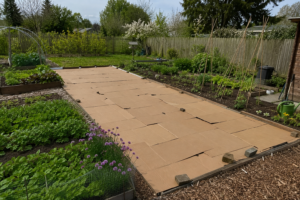
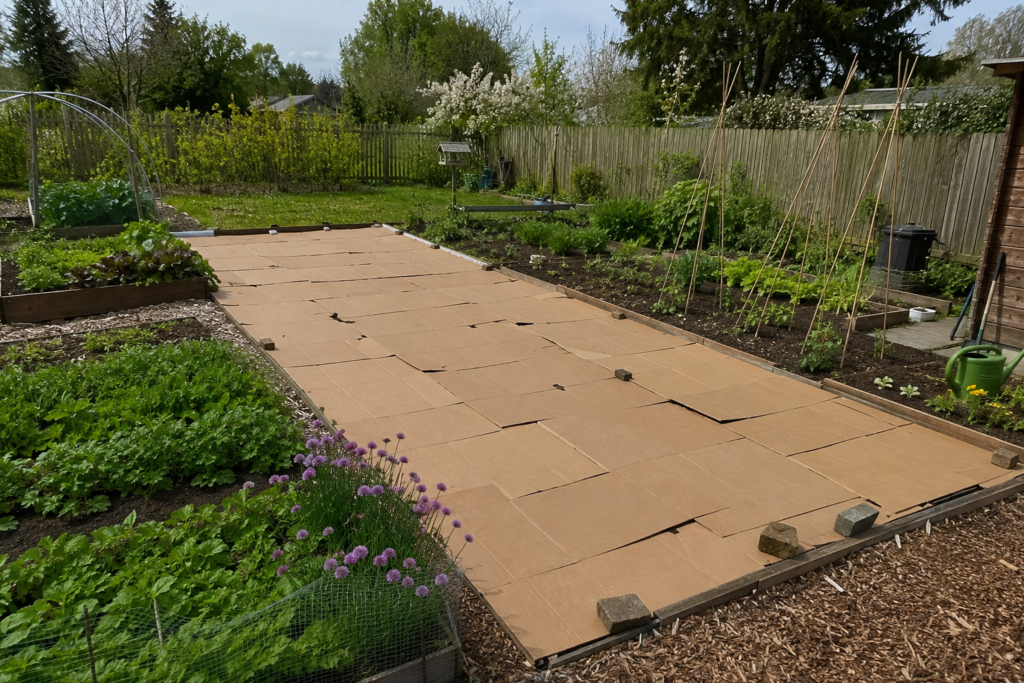
Spend five minutes scrolling through gardening social media and you’ll soon spot a familiar sight. Cardboard boxes are being flattened, soaked with water and laid across vegetable patches, flower beds and allotments. From first-time gardeners to seasoned growers, cardboard has become one of the biggest gardening trends in recent years.
But why is everyone suddenly covering their gardens with old Amazon boxes?

More importantly, is cardboard really the best long-term solution for weed control, or are there situations where a geotextile membrane simply performs better?
At Spudulica, we’re all for making gardening easier, so let’s dig into the pros, the drawbacks and where each option works best.
Why has cardboard become so popular?
Cardboard gardening isn’t actually a new idea. It’s been used for decades as part of the “no dig” gardening movement, where the aim is to disturb the soil as little as possible while improving its structure over time.
The idea is wonderfully simple.
Lay plain cardboard over existing grass or weeds, thoroughly soak it with water and cover it with compost, mulch or woodchip. The cardboard blocks sunlight, starving many weeds underneath while slowly breaking down into the soil.

It’s inexpensive, often free and gives a second life to packaging that would otherwise end up in the recycling bin.
For anyone starting a new vegetable patch or taking on an overgrown allotment, it can feel like a brilliant shortcut.
And in many cases, it works… at least for a while.
The catch with cardboard
Like many gardening hacks, cardboard has become incredibly popular online because it’s easy to demonstrate. What many videos don’t show is what happens six months or a year later.
Cardboard is designed to break down.
That’s fantastic if your goal is adding organic matter to the soil, but it also means its weed-suppressing ability gradually disappears.
As the cardboard softens, microorganisms, worms and moisture begin to break it apart. Eventually, weeds once again find light and space to grow.
Persistent perennial weeds can be particularly challenging. Plants such as bindweed, couch grass and horsetail often have enough energy stored underground to push straight through weakened cardboard or simply emerge around the edges.
This doesn’t mean cardboard doesn’t work. It simply means it isn’t a permanent weed barrier.
For gardeners who enjoy regularly topping up mulch and maintaining beds, that’s often perfectly acceptable.
For those hoping to reduce maintenance over many years, it can become frustrating.
Not all cardboard is created equal
Another issue is that not every cardboard box is suitable for use in the garden.
Many printed boxes contain coloured inks, glossy coatings or plastic tapes that should be removed before laying them on the soil. Heavy-duty packing boxes can also include adhesives that don’t break down as quickly as plain brown cardboard.
Removing staples, labels and tape can quickly turn a simple weekend job into an afternoon of preparation.
Then there’s the practical side.
Large areas often require dozens of boxes, and unless they’re overlapped generously, weeds will happily find every tiny gap.
After heavy rain or strong winds, lightweight cardboard can also move before it’s been covered with mulch.

Where geotextile comes into its own
This is where a quality geotextile membrane offers a completely different solution.
Rather than decomposing after a few months, geotextile is designed to provide long-lasting weed suppression while still allowing water and nutrients to pass through into the soil.
At Spudulica, our range of pre-cut geotextile membranes has become a favourite with homeowners and allotment holders looking for a more durable approach.
Unlike cardboard, a geotextile membrane stays in place season after season when installed correctly beneath decorative bark, gravel, slate or other mulch materials.
The result is far less maintenance and significantly fewer weeds finding their way through.
It also saves hunting around for enough cardboard every time you decide to tackle another part of the garden.
Can you use both together?
Absolutely.
Many experienced gardeners actually combine the two methods.
Cardboard can be useful for initially clearing heavily overgrown areas before planting, while geotextile provides the longer-term weed suppression for permanent landscaping features.
It’s not about one replacing the other.
It’s about choosing the right material for the job.
At Spudulica, we stock a wide range of premium pre-cut geotextile membranes ready for fast UK delivery, helping homeowners, gardeners and allotment enthusiasts spend less time battling weeds and more time enjoying the garden they’ve worked so hard to create.
After all, we’d all rather be harvesting tomatoes or relaxing with a cup of tea than chasing weeds that just won’t give up!